
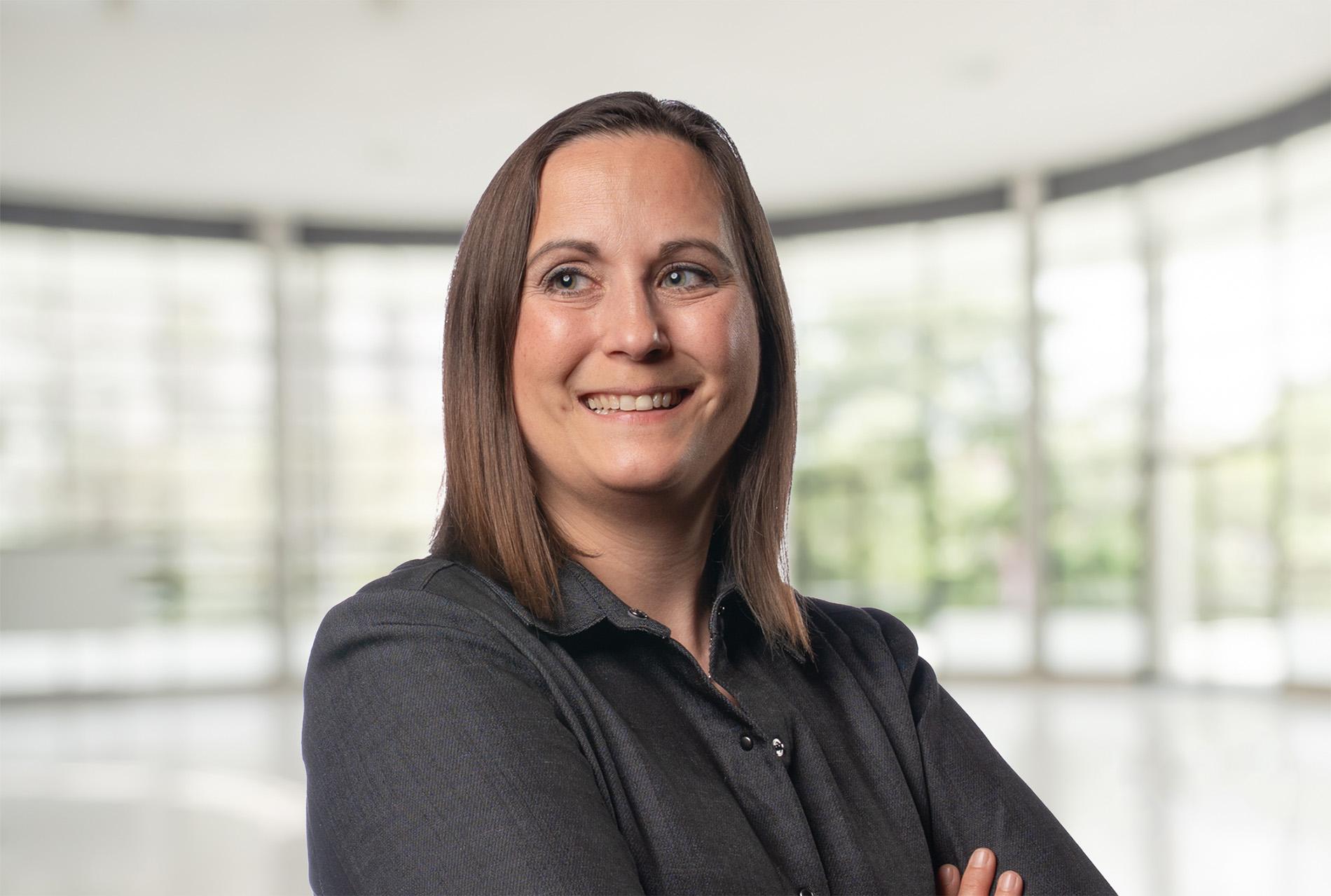
With three sociology degrees from George Mason, including master’s and doctoral degrees with concentrations in education and statistics, Olivia Blackmon, BA Sociology ’99, MA ’11, PhD ’15, brings a human-centered perspective to engineering and energy systems, emphasizing the role of organizations, behavior, and policy in shaping outcomes.
For more than 20 years, Blackmon has developed a career in critical infrastructure, regional innovation, partnership development, and business operations. She has worked with national governments, critical infrastructure operators, private sector partners, academia, and oversight bodies to address cybersecurity vulnerabilities across critical infrastructure sectors. Today, she serves as vice president of New Nuclear at MPR Associates, helping address the energy crisis.
“George Mason showed me that solving complex problems starts with understanding people.”
“My George Mason education prepared me to engage with national leaders on energy policy and national security, bringing an understanding of the human factors critical to these topics,” Blackmon said. “The ability to understand our global partners as individuals—where they’re coming from, their cultures, their perspectives—is integral toward solving the complex problem of energy infrastructure.”
What is a skill you gained from the sociology program you use every day?
The ability to look at topics from an intersectional approach. Sociologists consider different perspectives, whether it be cultural, human factors, or technical rigor. This is important in my role, as I look at the nuclear energy infrastructure and the critical infrastructure, to be able to have different perspectives, different approaches to solving complex problems in the nuclear field.
What problem are you helping to solve today?
The United States and the world are at a critical point when it comes to energy infrastructure. As vice president of New Nuclear at MPR, I lead two areas that support the future of energy infrastructure. One focuses on new nuclear commercialization and the second focuses on nuclear energy deployment. We’re focused on due diligence, such as ensuring that we’re setting these nuclear power plants in places without seismic issues. Nuclear energy supports a climate change solution, so as we look at energy and our emissions, it’s really important to have various types of energy solutions.
How did George Mason prepare you for solving these problems?
One of the most important lessons I learned at George Mason was understanding the strengths, values, and perspectives that each person brings to a team. Solving complex problems starts with bringing people together around a shared goal and valuing the different perspectives we each bring. George Mason provided an environment that encouraged critical thinking and collaboration, teaching me how to leverage diverse perspectives to tackle challenging problems. That approach continues to shape how I lead teams and solve complex issues today.
You’ve shared previously about working towards your graduate degrees while being a single parent. What was this experience like for you at George Mason?
Many of my professors helped build a community for me, ensuring that I would be successful in my educational journey while navigating some diverse challenges. They even invited my daughter into the classroom when I didn’t have a babysitter. George Mason is a large university, and I wasn’t expecting this type of individual-level of support. My ability to connect with our faculty, and our faculty to show their commitment to my education in this unexpected way, was an invaluable part of my experience at George Mason.