
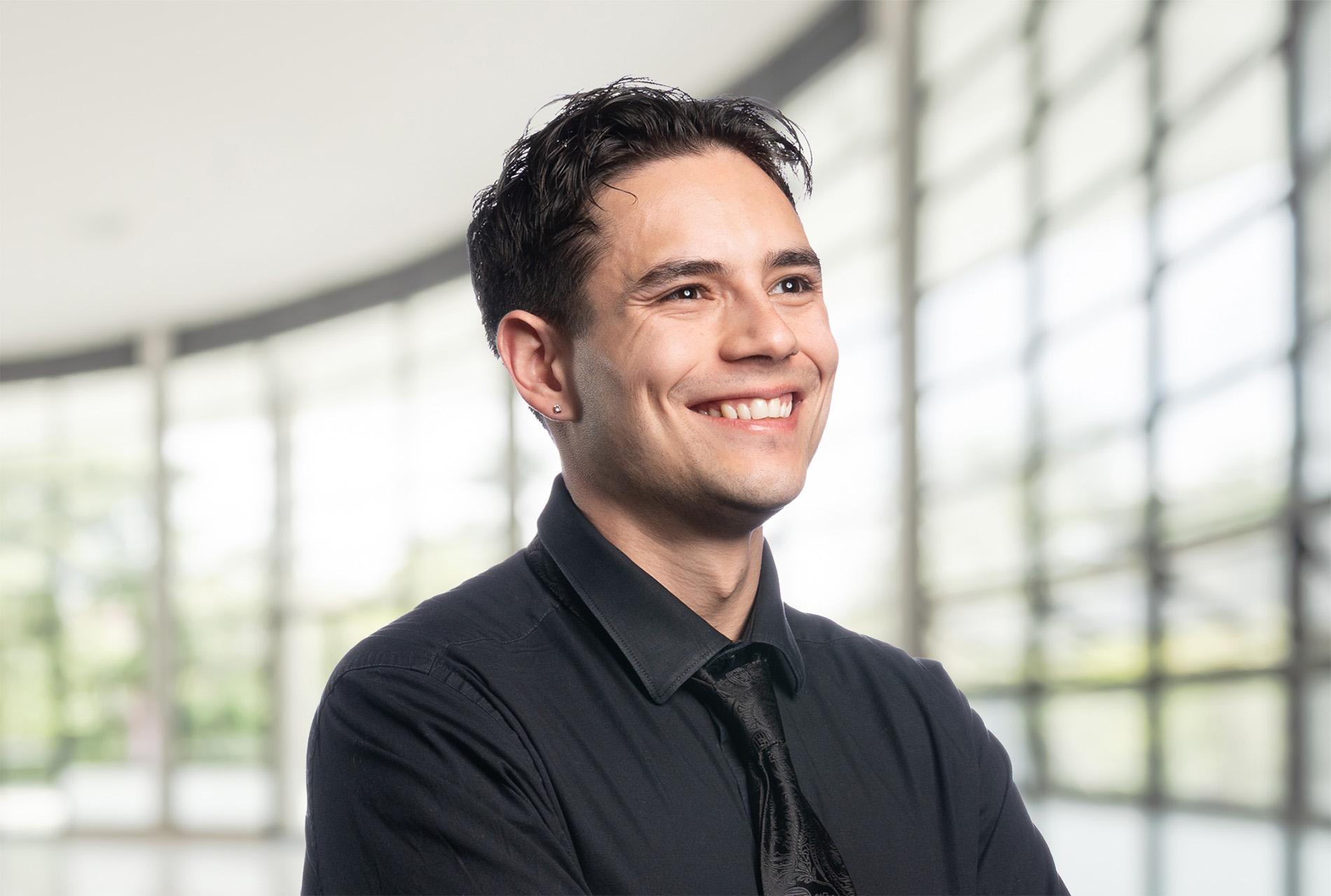
As a PhD student in the Applied Psychology and Autonomous Systems (ALPHAS) Lab in the Human Factors and Applied Cognition Program at George Mason, Andres Rosero, MA Psychology ’22, PhD ’25, was able to delve into research with far-reaching implications surrounding the future of artificial intelligence.
While at George Mason, he focused on human-robot interaction and the psychology of deception, studying how people perceive trust, intent, and credibility in artificial intelligence systems. His research sits at the intersection of psychology, technology, and ethics—fields that are increasingly interconnected as AI becomes more embedded in everyday life.
“George Mason taught me that research is most valuable when it helps improve people’s lives.”
Now a data scientist at Aptima, a defense engineering company that integrates advanced technology with core insights into human behavior and cognition, his research has contributed to a growing body of knowledge that helps shape how intelligent systems are designed and deployed. His work focuses on ensuring that people feel empowered, not manipulated, when interacting with AI and robotics, and fostering relationships in which humans remain active participants rather than passive users.
“George Mason prepared me for this role by giving me the tools to begin my own research and to be independent in terms of my ability to start projects, finish projects, and understand the value of those projects in a real-world environment,” recalls Rosero.
What role does psychology play in the future of AI?
There are a lot of different ways that AI will play a role in the future, but functionally, the way in which humans trust and commit aspects of their own knowledge base and offload it to technology will severely impact the way in which that artificial intelligence models and all artificial intelligence models are implemented in a day-to-day basis.
How much of your ability to do everyday tasks—be it writing or processing information—do you offload onto an agent? And how much of it do you automate using artificial intelligence? These answers will determine the role in which humans will shape the integration of artificial intelligence over time.
What problems are you helping solve today?
I’m trying to help solve the problem of how to properly integrate artificial intelligence and robotics in such a way where humans feel like they are both involved and empowered in the agent-robot relationship. How do we ensure that when humans interact with artificial agents, they feel like they’re not being manipulated, and that they’re able to retain their own expertise, their own knowledge—the things that make humans great—through that process?
How did George Mason prepare you for this work?
I learned that it’s not just about doing science in a vacuum but doing science in a way where we ensure the outcomes are helping people in our society. George Mason was incredibly valuable in showing me the importance of the research that I’m doing, on top of the skills necessary to conduct that research at a high level.
What did your George Mason experience make possible for you?
It has opened so many doors. It has given me a sense of discipline and passion for science, and research in general. The ability to be in an environment where everyone is incredibly intelligent, determined, and passionate about what they do was incredibly important towards my development as a person and researcher. It taught me how to be someone who is willing to put the work in and to be proud of putting the work in, while knowing that over time, I will eventually reap the benefits of that work if I just stay determined and focus on believing in myself.
What was the most powerful thing you learned at George Mason?
The most powerful thing I learned at George Mason is the power of community—how to use the skills of others to not just help you advance, but to advance everyone and the field as a whole. Being able to learn from others and being able to express that gratitude back by teaching others is something I’ve learned as well.
Why is it important for George Mason alumni to stay connected with our university community?
I believe George Mason alumni should stay connected to the university after graduating because there is a new generation of students coming after us who will be facing the same challenges, or even new challenges, that they might not anticipate when starting their degree. It’s important to keep the door open after you graduate and extend a hand and let them know what you went through and help guide them through any difficult moments. As an alum, I stay connected because I want the next generation to succeed, and I want to do what I can to help guide them.